
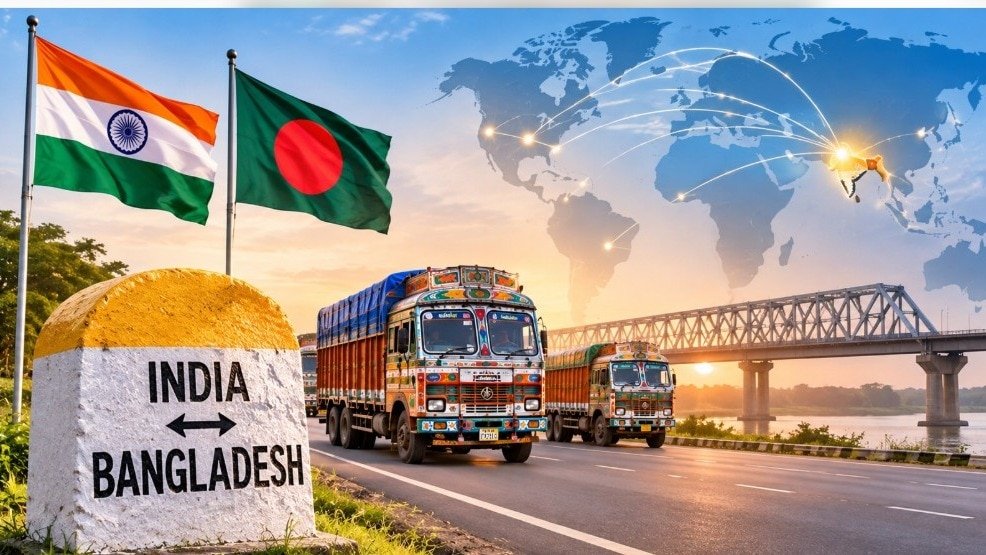
Why is the India–Bangladesh border necessary?
The report identifies the India–Bangladesh border amongst Asia-Pacific’s strategic chokepoints, alongside the Strait of Malacca, Taiwan Strait and main Chinese language ports.
Cross-border connectivity helps the motion of products between the 2 neighbouring economies and facilitates regional provide chains.
Nonetheless, the report flags 4 potential threats: migration tensions, smuggling, safety restrictions and congestion.
These challenges might have an effect on the effectivity of cross-border commerce, significantly the place industrial motion depends upon restricted infrastructure and border-processing capability.
The report doesn’t quantify the worth of commerce uncovered to those dangers or determine particular person border crossings.
How can border disruptions have an effect on companies?
In response to the WEF, chokepoints are strategically necessary connections by way of which items, sources, providers or data transfer, typically with restricted options.
Their disruption can create cascading penalties throughout interconnected financial techniques.
For companies buying and selling throughout the India–Bangladesh border, tighter safety checks or congestion might doubtlessly enhance transportation prices, delay shipments and complicate stock planning.
Industries depending on predictable cross-border motion might face further logistical challenges when clearance procedures grow to be slower or much less dependable.
Such dangers underline the significance of environment friendly customs processing, dependable transport infrastructure and coordination between authorities.
Why are commerce chokepoints changing into extra important?
The WEF report argues that globalisation and digitalisation haven’t eradicated the significance of bodily infrastructure.
Maritime routes, ports, border crossings and logistics hubs stay important to financial exercise, at the same time as worldwide commerce turns into more and more technology-driven.
The importance of a chokepoint relies upon not solely on commerce volumes but in addition on the supply of different routes and the results of disruption.
Geopolitical tensions, governance challenges and altering financial circumstances can additional enhance vulnerabilities.
What can enhance regional commerce resilience?
For India and Bangladesh, stronger border infrastructure, improved logistics coordination and extra environment friendly customs procedures might assist scale back potential bottlenecks.
The WEF recommends that companies determine crucial dependencies, assess different routes and strengthen contingency planning earlier than disruptions happen.
Its broader message is that strategic resilience requires anticipating dangers fairly than responding solely after commerce flows are interrupted.
Whereas the report doesn’t prescribe particular measures for the India–Bangladesh border, its findings spotlight the significance of dependable connectivity in supporting regional commerce and supply-chain stability.


